[Reading time: 7 minutes]
Overview
Voice smart routings process your call flow through various actions. They act as decision trees that qualify and route incoming calls by executing a sequence of configurable actions — such as playing voice announcements, capturing DTMF or speech input, testing values, distributing to queues or agents, transferring to phone numbers or SIP endpoints, recording the call, or calling web services.
Each smart routing contains versions that go through a lifecycle: development → testing → production. This versioning system allows you to prepare and validate changes before deploying them, while keeping previous versions as backups.
A voice smart routing can be of two types:
| Type | Description |
|---|---|
| Interaction start | The smart routing is invoked when a call comes in. |
| Interaction end | The smart routing is invoked when a call ends (typically used for post-call qualification, surveys, or callbacks). |
Prerequisites
- A Smart license.
- Access to the Maker.
- The Smart routing permission enabled in your role (read, create, edit, and/or delete).
- For testing: at least one phone number (entry point) configured.
- Recommended: value tables, variables, distribution queues, sound files, TTS voices, voicemails and calendars pre-configured, as they are commonly used in voice smart routing actions.
1. Creating a voice smart routing
- In the Maker, navigate to Routing > Voice smart routings.
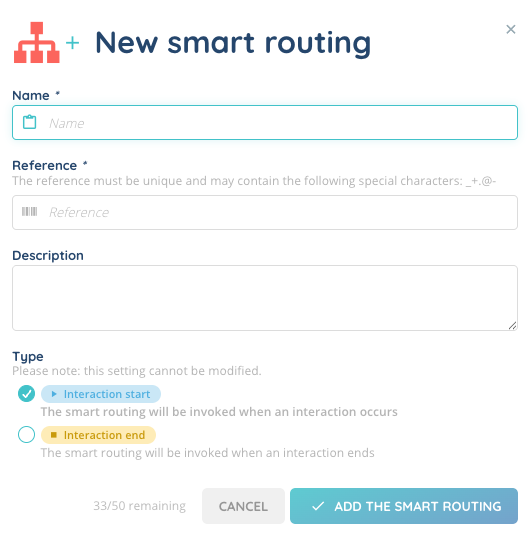
- Click New smart routing.
- Fill in the following fields:
| Field | Description |
|---|---|
| Name | Name of the smart routing. |
| Reference | Unique reference code for the smart routing. |
| Description | Optional description. |
| Type | Interaction start (invoked when a call comes in) or Interaction end (invoked when a call ends). This field cannot be modified after creation. |
- Click Save.
Note: You can also create a smart routing by duplicating an existing one using Copy the smart routing.
2. Version management
Once a smart routing is created, you manage its logic through versions. Each version contains its own action tree and goes through a defined lifecycle.
2.1. Version statuses
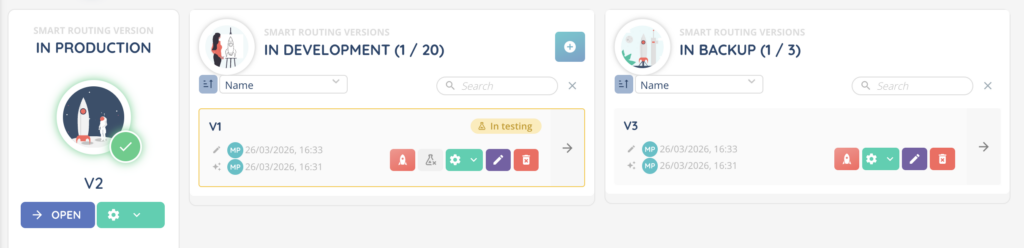
| Status | Description |
|---|---|
| In development | A working version that can be freely edited. You can have multiple development versions. |
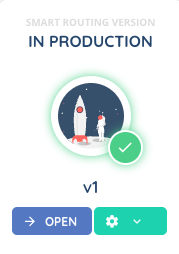
| In production | The active version currently processing incoming calls. Only one version can be in production at a time. |
| In backup | A replaced production version. When a new version is put into production, the previous production version automatically goes into backup. You can put it back into production at any time. |
2.2. Creating a version
- From the smart routing detail page, click Create in the In development section.
- Choose how to create the version:
- From zero: start with a blank action tree.
- Copy an existing action: duplicate an existing version’s action tree.
- Fill in the Name and optional Description.
- Click Create the version.
Note: If no versions exist yet, a helper message is displayed: “Create a version of this smart routing to manage your incoming interactions. You can then place it in production.”
2.3. Version actions
On each version card, depending on its current status, the following actions are available:
| Action | Availability | Description |
|---|---|---|
| Edit | In development | Open the version to modify its action tree and settings. |
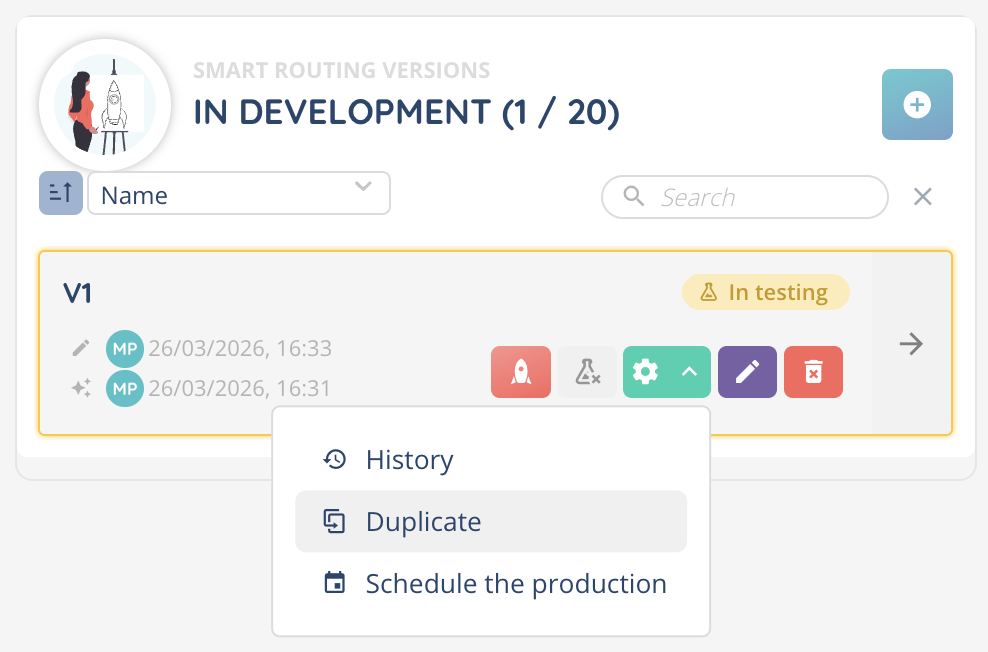
| Put in production | In development | Move the version to production. The current production version (if any) automatically goes into backup. The version becomes read-only. |
| Put in test | In development | Activate test mode on this version (see 4. Testing a version). |
| Remove from test | In development (test mode) | Deactivate test mode. |
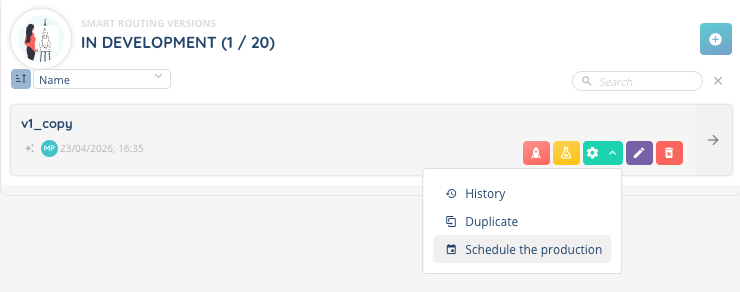
| Schedule the production | In development | Schedule an automatic production at a future date and time (see 6. Scheduling). |
| Remove the planned production from the schedule | In development (scheduled) | Cancel the scheduled production. |
| Duplicate | Any status | Create a new development version by copying this version’s action tree. |
| Delete | In development / In backup | Permanently delete the version. |
Note: A production version cannot be edited. To make changes, you need to create or copy a development version.
3. Building the action tree
Each version contains an action tree — a visual flow of connected actions that define how the smart routing processes calls.
3.1. Adding actions
- Open a version in development.
- The tree starts with a Start action (automatically created).
- Click Add an action to add a new action after an existing one.
- Select the action type, configure its parameters, then save.
Actions can also be added between two existing actions using the “Add an action between these 2 actions” option, or created from zero or by copying an existing action from the same or another version.
3.2. Positioning and connections
When adding an action, you configure:
| Field | Description |
|---|---|
| After the action (Positioning) | The parent action this new action follows. |
| Following action (Connection) | The child action that follows. |
| In the branch | If the parent action has multiple output branches, select which branch this action belongs to. |
3.3. Action tracking
Each action has an optional Record the passage in this action toggle. When enabled, a log is displayed in the interaction events list, allowing you to trace the path taken through the smart routing.
3.4. Available action types
Actions are grouped into categories. The detail of each action’s configuration is covered in a dedicated article.
Actions and action tree
- Start
- Load sharing
- Add a checkpoint
- Pause
- Node
Voice
- Voice announcement
- Speech recognition (ASR)
- Test if the number is mobile
- Modify the caller ID
- Start a recording
- Stop a recording
- Digitalization
Sending
- Send an email
- Send a SMS
Distribution
- Distribution to queue
- Distribution to a number
- Distribution to a smart routing
- Distribution to a user
- Distribution to a voice mailbox
- Distribution to SIP endpoint
Cases & CRM
- Associate the interaction with a case
- Dissociate the case from the interaction
- Create a new case and associate it with the interaction
- Modify a case
- Associate the interaction with a CRM card
- Create a CRM card
- Associate the interaction with a CRM V2 card
- Create a CRM V2 card
- Create a task
Data
- Assign values to variables
- Test a value(s)
- Values table
- Fill in the variables from a database
- Save values to a database
- Modify the values of a database
- Date and time (retrieval and calculations)
- Check the number of passages
- Check Nth contact
Time and dates
- Test a schedule
- Test if it is an even or odd week
Interconnection
- Web service
Campaigns
- Insert a target in a WhatsApp campaign
- Insert a target in a voice campaign
- Insert a target in the SMS campaign
- Check the number of target attempts
- Check the result of the target attempts
- Reschedule an attempt
Survey
- Survey
Payment and billing
- Search for invoice
- Pay an invoice
4. Testing a version
Before putting a version into production, you can activate test mode to validate its behavior with real calls.
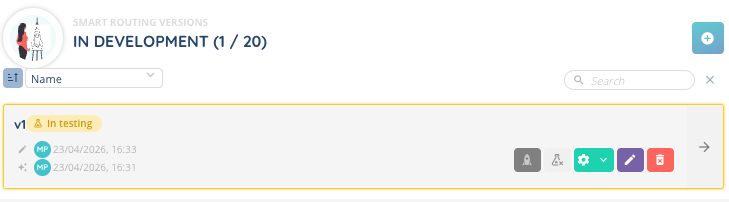
- From the version card, click Put in test.
- The version is tagged as In testing.
- Entry points used for test versions are displayed on the version card — these are the phone numbers you can dial to send test calls to this version.
To view the details of the last execution, the History panel tab on the version page shows the test execution history.
To stop test mode, click Remove from test.
5. Putting a version into production
When a version is ready, you can deploy it to production.
- From the version card, click Put in production.
- A confirmation dialog explains:
- The version will become read-only — to make further changes, you will need to create or copy a development version.
- If this smart routing already has a production version, it will automatically go into backup. You can put it back into production at any time.
- Confirm to proceed.
Note: You cannot put a blank version (with no actions) into production.
6. Scheduling an automatic production
Instead of immediately deploying a version, you can schedule it to go into production at a specific date and time.
- From the version card, click Schedule the production.
- Set the Date and time of the automatic production.
- Click Save.
The version card displays an alert: “This version has been put in scheduled production for [date]”.
If a scheduled production is already set, a banner also appears in the production section: “Automatic production of version [name] on [date]”.
To cancel the scheduled production, click Remove the planned production from the schedule on the version card.
Note: The chosen date and time must be in the future. You cannot schedule two productions on the same date.